
Blade Angle: Choosing Your Viper Blade with Confidence
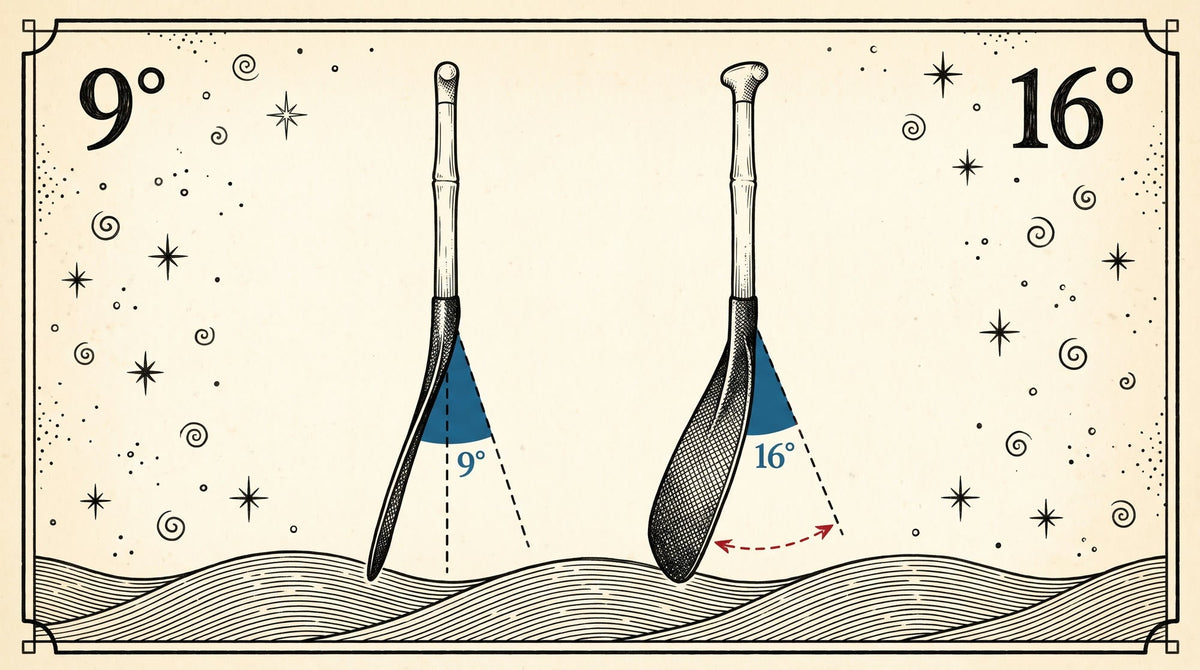
If you're choosing between a 9° and 10° Viper Va'a outrigger blade, don't turn one degree into a crisis. These are fine-tuning choices, not separate performance classes. A 9° puts the blade's strongest point earlier in the stroke. A 10° moves it farther back, trading some catch power for lift and a longer stroke. Most paddlers won't consciously feel the difference.
Choose your blade surface area and shape first. Then use angle to finish the spec.
Quick Call: 9° or 10°?
| Spec | 9° | 10° |
|---|---|---|
| When the blade is strongest | Earlier in the stroke | Farther back in the stroke |
| Catch | More catch power | Trades some catch power |
| Lift | Less lift than 10° | More lift than 9° |
| Stroke length | Shorter than 10° | Allows a longer stroke |
How noticeable is one degree? For most paddlers, not very. The change is real, but it's subtle. Your boat, your stroke, and the rest of the blade spec matter more than trying to make 9° and 10° sound worlds apart.
What Blade Angle Changes
The blade's "sweet spot" is the point in the stroke where it's strongest. That happens when the blade is straight up and down — perpendicular to the ground — so its work goes into moving the canoe forward. Blade angle changes where in the stroke that point falls.
A 9° blade reaches that strongest point earlier, which puts more of the emphasis at the catch. A 10° blade reaches it farther back, giving up some catch power for more lift. And because it reaches the strongest point later, it allows a longer stroke.

That's the whole decision. No magic degree. No universal winner. Just a small shift in where the blade does its strongest work.
OC6 and V6: Match the Angle
Crew blend is bigger than any one seat. In an OC6 or V6, blade angle is one of the most important specs to match, because it helps every paddler apply power in the same direction through the stroke.
That doesn't mean every paddle must be identical. It means angle should be a crew-level decision, not six separate guesses. It's one of the most overlooked specs when clubs mix brands.
How Viper's Angle Compares
Angle is a personal preference, so treat these numbers as context, not a target to chase. Here is how Viper's 9–10° range sits next to what other brands publish, on the models we confirmed. Where a brand doesn't list an angle, we left it out rather than guess.
| Brand | Published blade angle |
|---|---|
| Viper (SoCal Va'a) | 9–10° |
| Kialoa | 10–16.5° on the models we confirmed |
| Palafamala | 10° — the brand's standard, per its authorized dealer |
| Puakea Designs | 10° on the Kahi Classic; not published on the other models we checked |
| Quickblade | 12° on the Stingray family; 15° on the Toa Hoe Hybrid |
See the current Viper build options or get free spec help.
Viper Blade-Angle FAQs
Why does an outrigger paddle blade have a forward angle?
A forward blade angle helps the blade face reach an effective working orientation during the stroke. It also sets when the blade reaches its strongest point.
What is the difference between a 9° and 10° Viper blade?
A 9° reaches its strongest point earlier and keeps more emphasis at the catch. A 10° moves that point farther back, trades some catch power for lift, and allows a longer stroke. The one-degree difference is subtle for most paddlers.
Why does matching blade angle matter in an OC6 or V6 crew?
Matching angle helps the crew apply power in the same direction from every seat through the stroke. It's one of the most important paddle-spec considerations for crew blend.
What if I still can't decide?
Ask. Tell us your boat, your seat, and how your current stroke feels, and we'll propose a spec — that's free spec help. The current build options are always on the order page.
Ready to Build?
You don't need one degree to carry the whole decision. Choose surface area and shape first. Use 9° or 10° to fine-tune where the blade is strongest in your stroke. Then go paddle.
Build your custom Viper Va'a outrigger paddle or ask SoCal Va'a for free spec help.