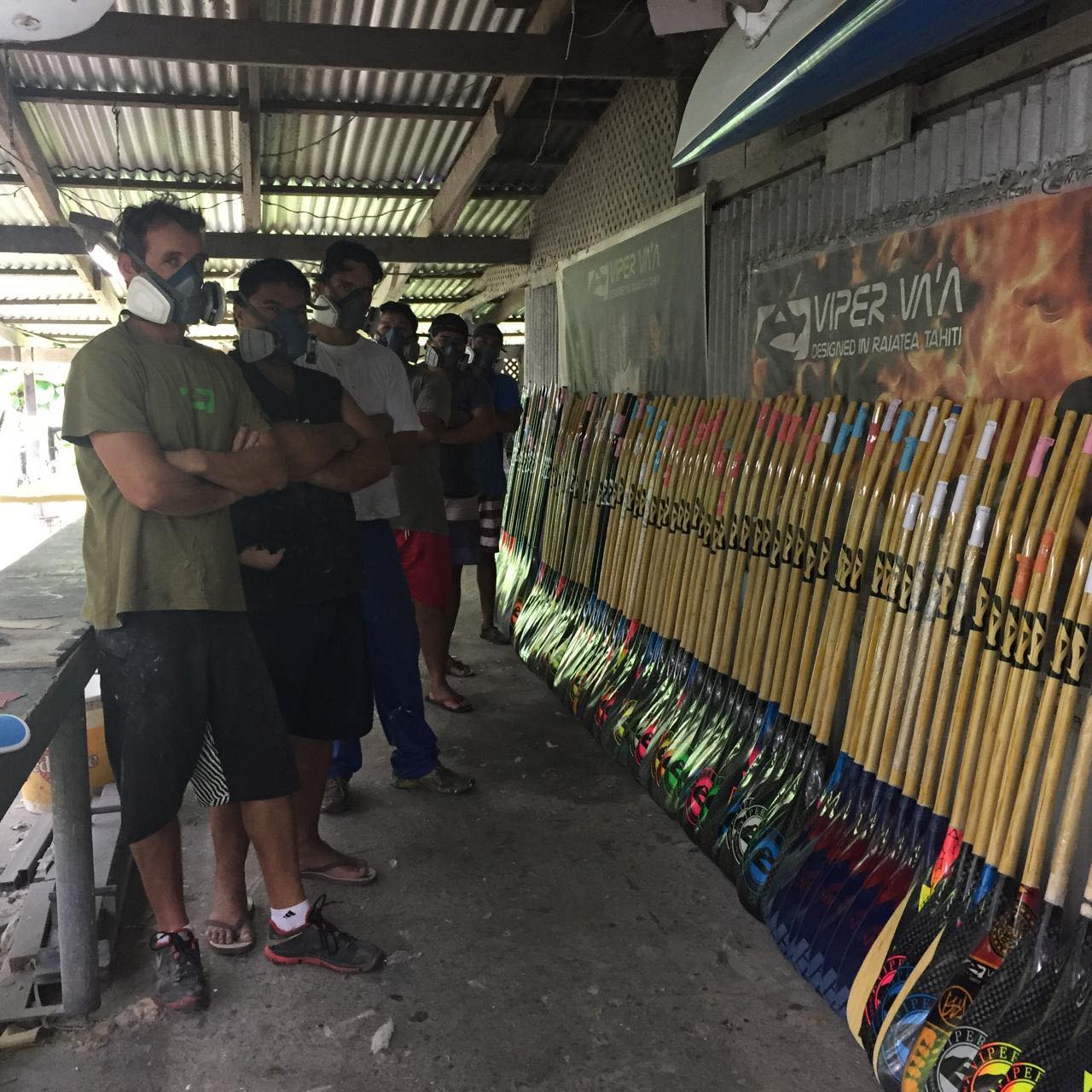
Viper Va'a workshop crew in respirators before the paddle wall — photo @vipervaa

SoCal Va'a Journal · The Build

Where Your Paddle Is Born

Inside the Viper Va'a workshop on Ra'iātea — carbon, bamboo, and eighteen years of Tahitian craft.

01 · The Island

Not Assembled. Made.

Every Viper Va'a paddle we sell starts about 4,000 miles southwest of the Southern California coast, on Ra'iātea — the island Tahitians call sacred, the old launching point of the great Polynesian voyages.

In the Tehurui district on the island's west coast, a crew of about fifteen builders shapes, molds, sands, and finishes every single blade by hand. Nothing is jobbed out. Raw carbon, bamboo, and local falcata wood go in one end of the shed; race-ready paddles and wood-hulled canoes come out the other, each carrying the line that says it all: proudly made in Ra'iātea.

That's rare. Most performance paddles are molded in factories in Asia and badged elsewhere. Viper went the other way and kept the whole build on an island of twelve thousand people — and then out-built everyone anyway.

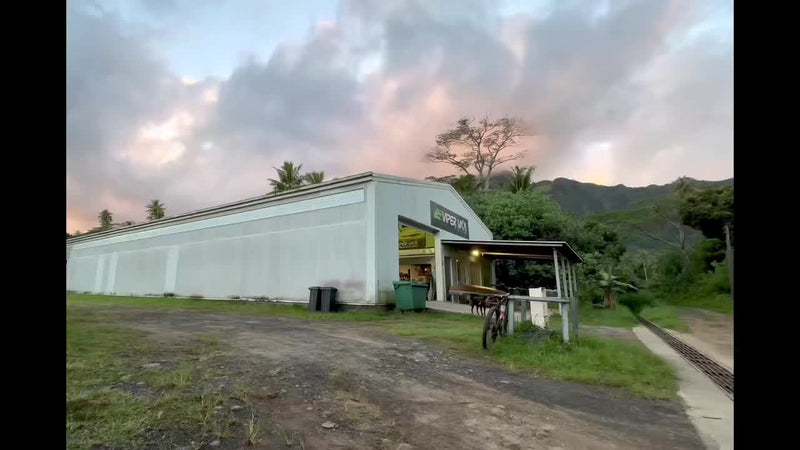
The Viper Va'a workshop at dusk, Tehurui Ra'iātea — photo @vipervaa

The shed at Tehurui, Ra'iātea — dusk. Photo · @vipervaa

02 · The Builders

"I Made One. Then Two. Then…"

Alex and Nathalie Pelou trained as nurses in Switzerland, landed in Tahiti in 2002, and settled on Ra'iātea. When their diplomas weren't recognized by the local hospital system, Alex opened a kite school instead. Paddlers from the lagoon started bringing him busted gear to fix. He fixed it. Then he built his own — composite blades roughly three times lighter than the wooden paddles of the day. The locals side-eyed the newcomers' paddles right up until the race results came in.

By 2008 the side project had a name. By 2010, the powerhouse EDT crew was racing Hawaiki Nui Va'a with Viper's carbon 'īato crossbeams while the rulebook still assumed wood — officials let them start, breakage on their own head. "I prayed," Alex remembers. EDT went on to take seven Hawaiki Nui titles on Viper equipment, and the shed on the west coast quietly became the paddle-maker to Tahiti's best.

Est. 2008Self-TaughtRace Proven
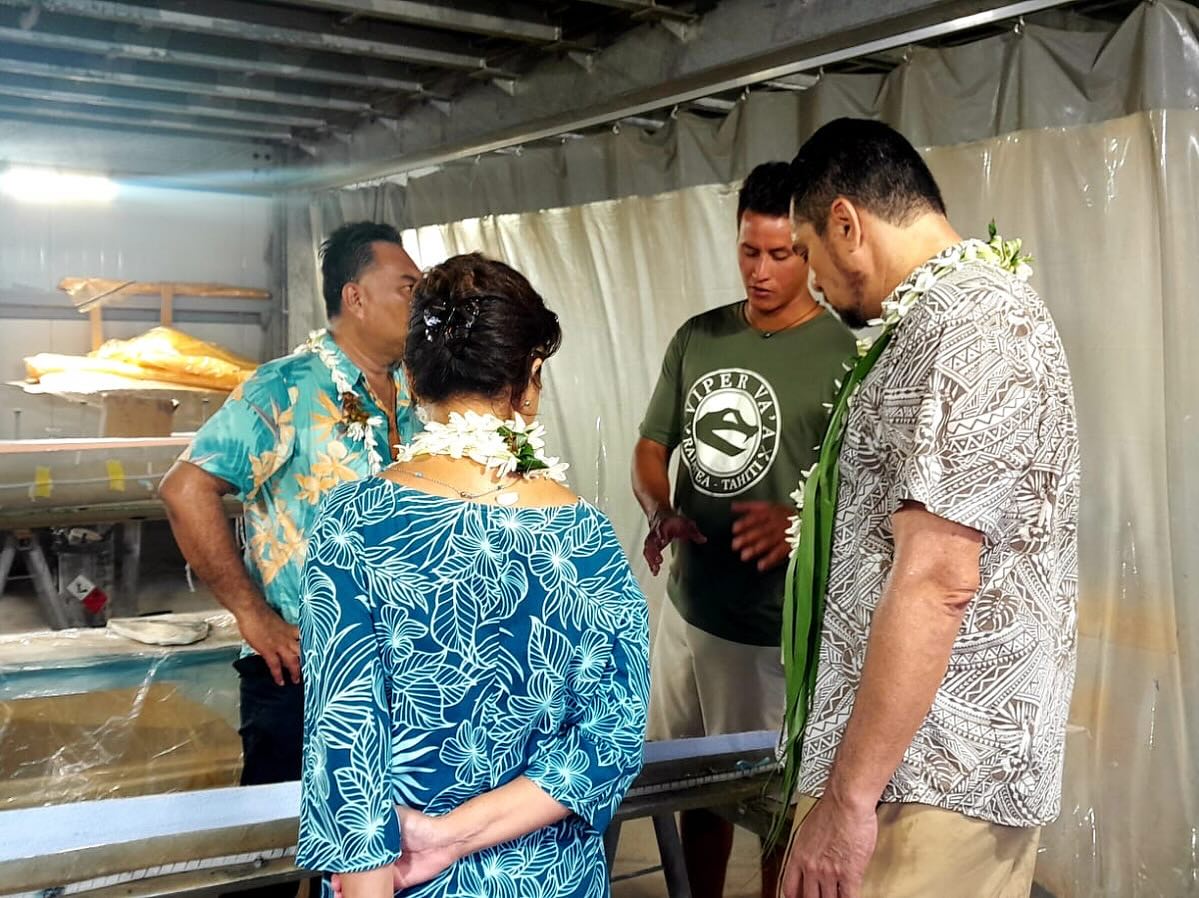
Workshop crew mid-morning break — photo @vipervaa

Mid-morning break — "a quick snack, a good laugh, in a tight-knit team." Photo · @vipervaa

03 · The Materials

Three Materials, One Shed

Carbon · Bamboo · Falcata
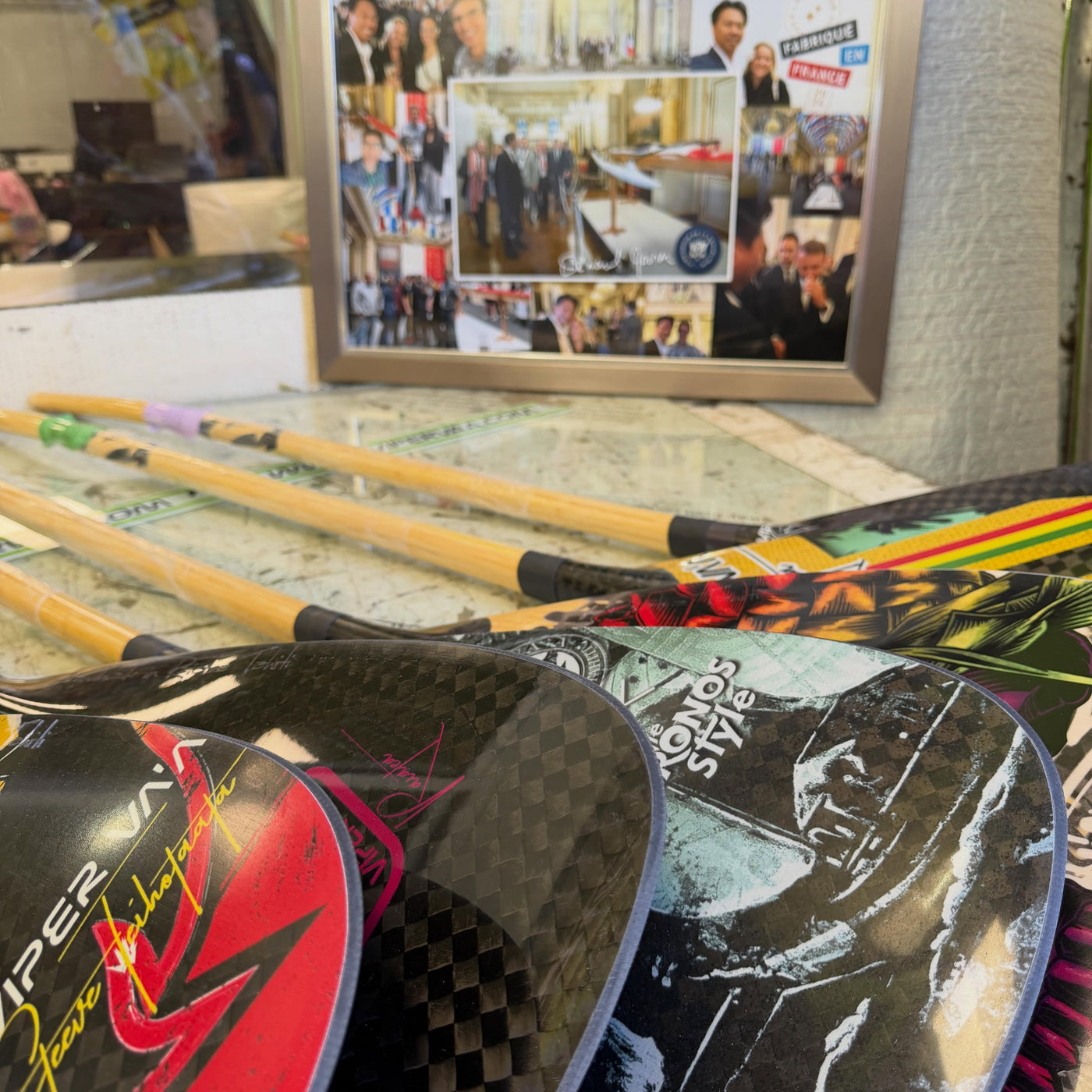
Carbon-weave blades and bamboo shafts on the ProShop counter — photo @vipervaa

Multiaxial Carbon

Stiff Where You Pull

Carbon fiber laid in multiple directions, so the blade is rigid on the power face and tough everywhere else. Full-carbon builds are the lightest, hardest-hitting option in the range — the pick of sprinters and most of the pro team. Viper is credited with putting carbon paddles into French Polynesian racing in the first place.
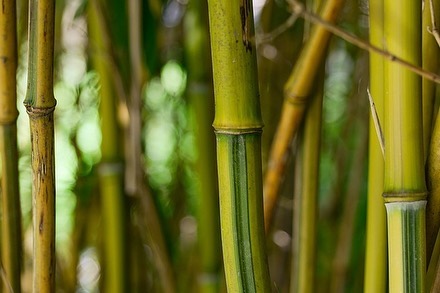
Bamboo stalks — photo @vipervaa

Bamboo

Flex That Forgives

Bamboo isn't a tree — it's a grass, one of the fastest-growing plants on earth. Laminated into a shaft it springs back stroke after stroke and goes easy on shoulders and elbows. That flex is the Tahitian distance style. The soft shaft option is 100% bamboo; put it under a carbon blade and you get the fusion build — power where it counts, forgiveness where it counts more.

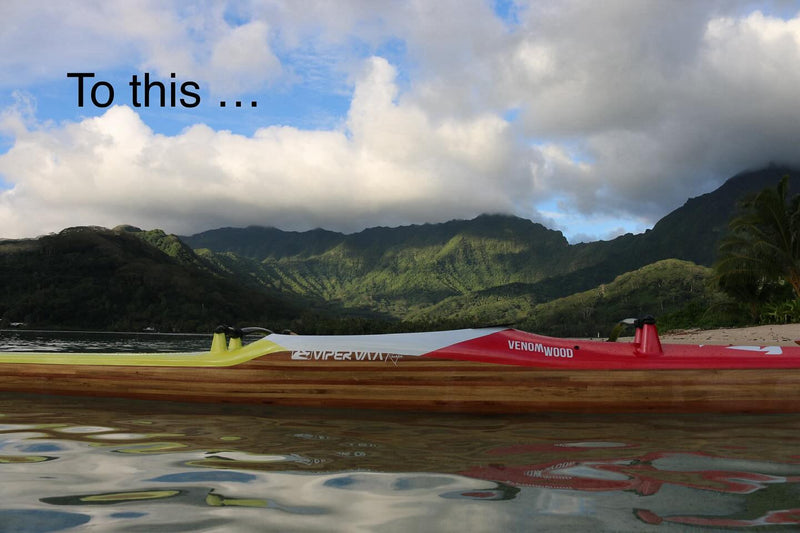
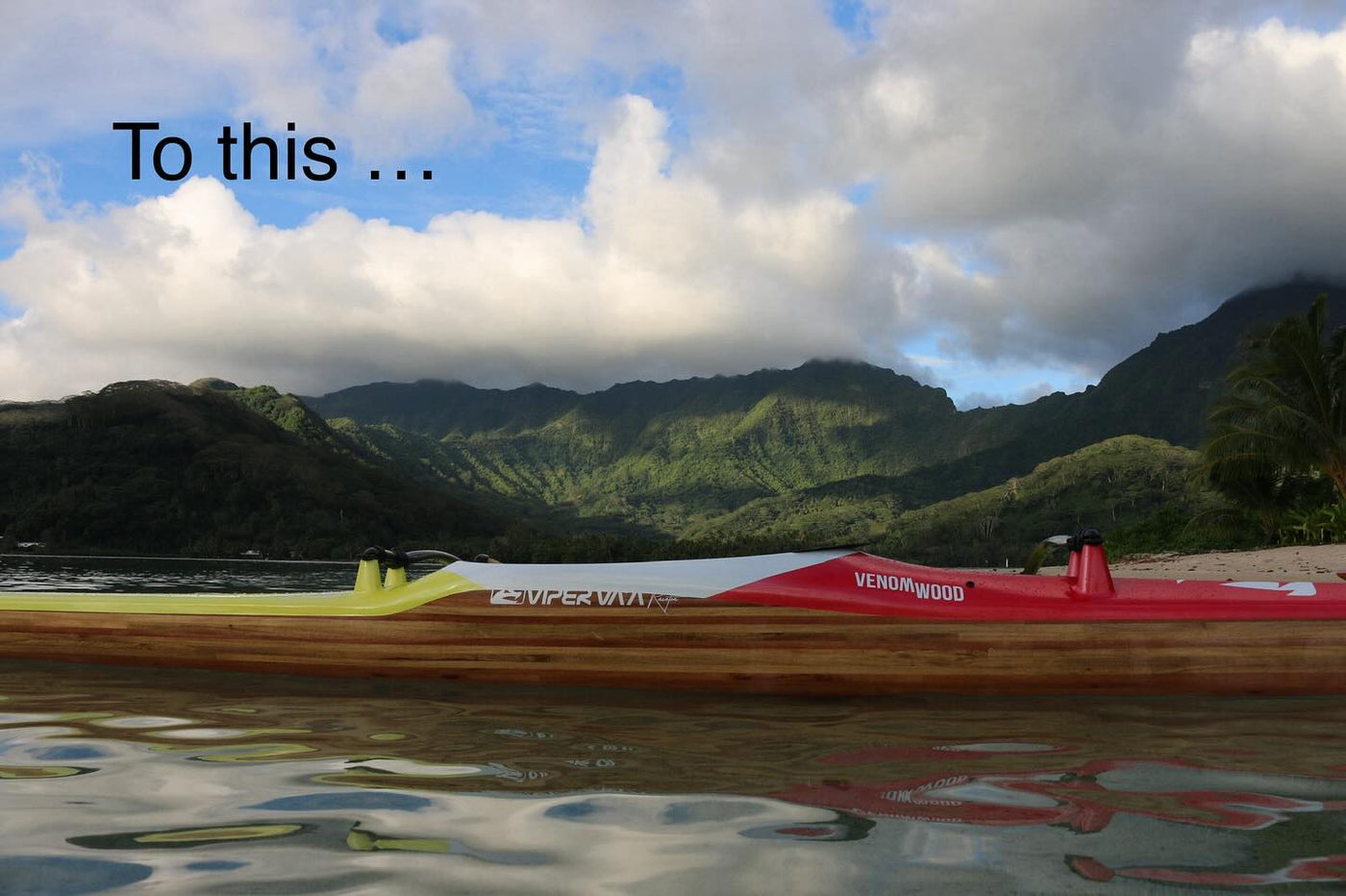
VenomWood V1 with falcata hull on the lagoon — photo @vipervaa

Falcata · VenomWood

A Problem Tree, Turned Weapon

This one isn't in your paddle — it's the canoe under it. Falcata was planted across French Polynesia in the early 1900s and went invasive. It's featherlight and handles compression — ideal once it's reinforced with carbon. Viper turned the problem tree into VenomWood: real-wood V1 hulls wrapped in a high-tech carbon process, built in the same shed as your blade. It carried the brand to the Élysée Palace for the Made-in-France exposition in 2024.

04 · The Build

Eight Moves, One Blade

Tehurui Workshop · Ra'iātea
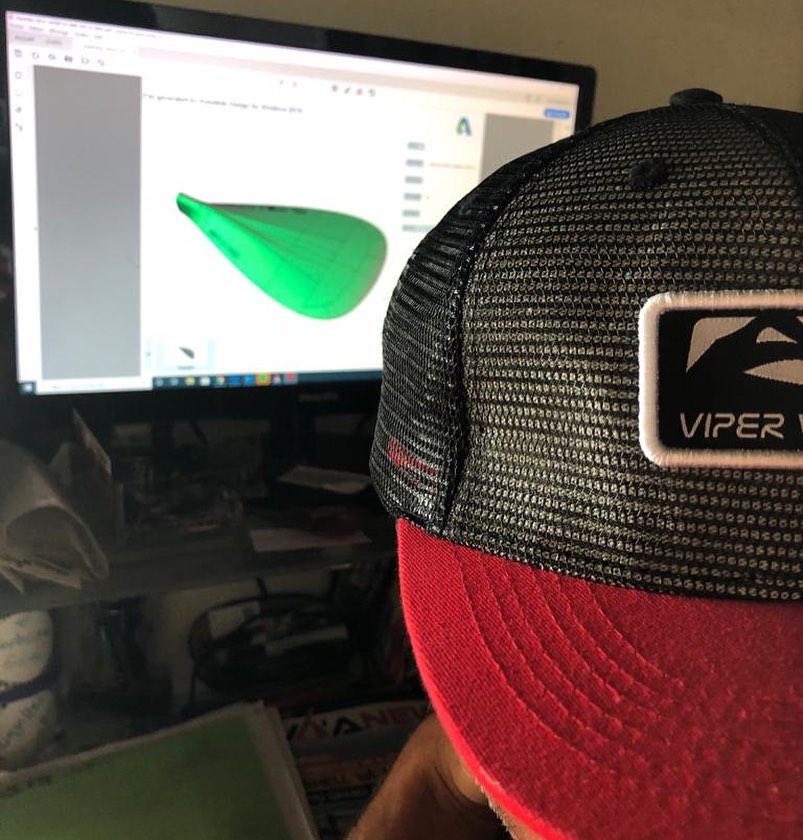
Blade shape digitized in CAD at the workshop — photo @vipervaa
Move 01

Draw It

Blade shapes are designed alongside the pro riders — Steeve Teihotaata, Kevin Ceran-Jérusalémy, Iloha Eychenne, Manutea Millon — and refined every season. Last season's hand-shaped prototypes get digitized into CAD as the starting point for the next one.

Prototypes becoming 2020 models. Photo · @vipervaa

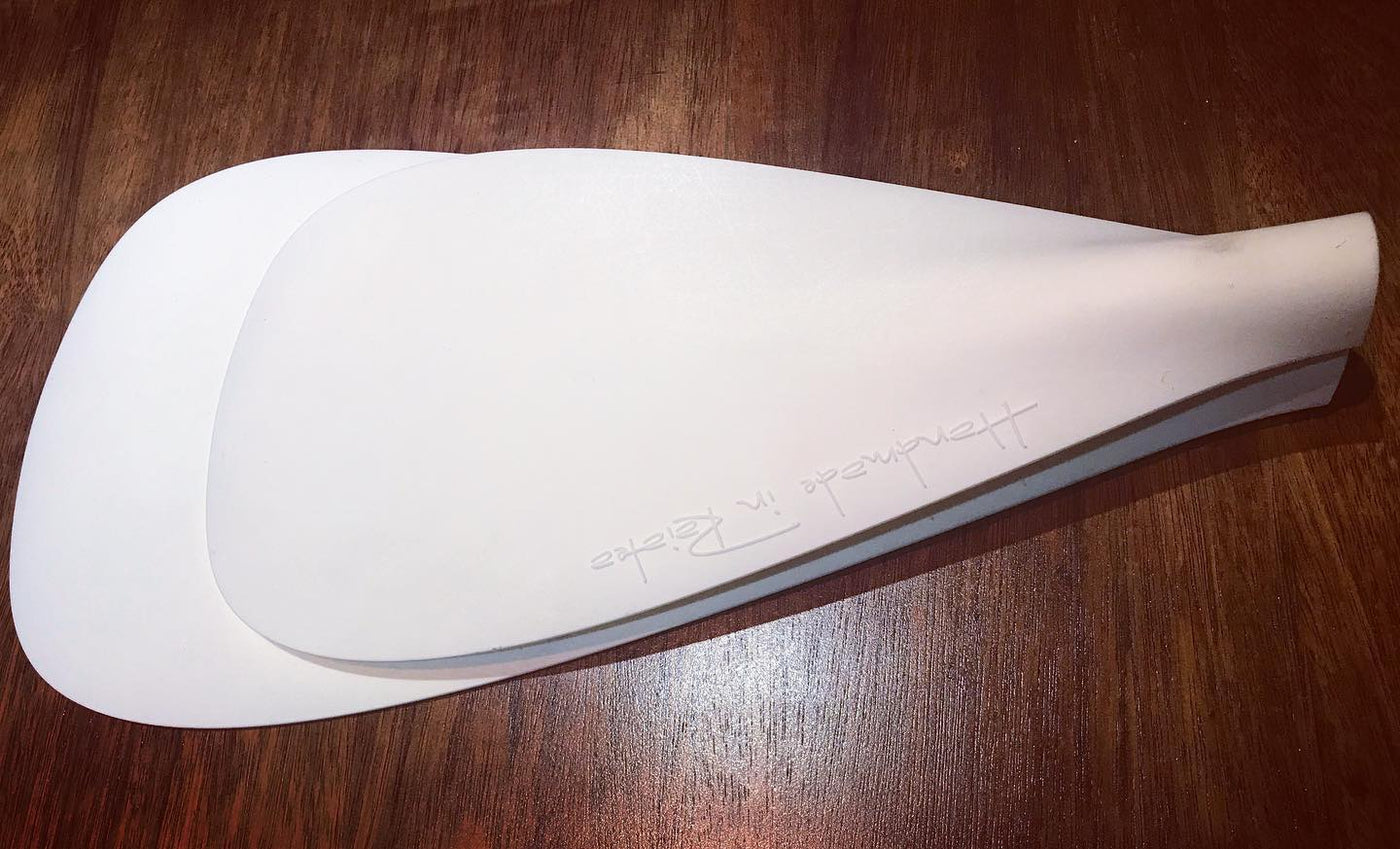
3D-printed kids blade prototype, engraved Handmade in Raiatea — photo @vipervaa
Move 02

Print It, Prove It

New shapes come off the workshop 3D printer as full-size prototypes — this one a 19.5 × 38 cm kids blade — and get paddled in the lagoon before anything goes to production. If it doesn't feel right in real water, it doesn't ship.

Proto, fresh off the printer. Photo · @vipervaa

Inside the molding room at Tehurui — photo @vipervaa
Move 03

Make The Mold

Every blade size gets its own precision mold — 22.5 × 47 up through 26 × 48.5, round or square profiles, each with its own blade angle. The mold room is where a season of design work becomes steel-hard tooling that will pull thousands of identical blades.

The molding room, Tehurui. Photo · @vipervaa

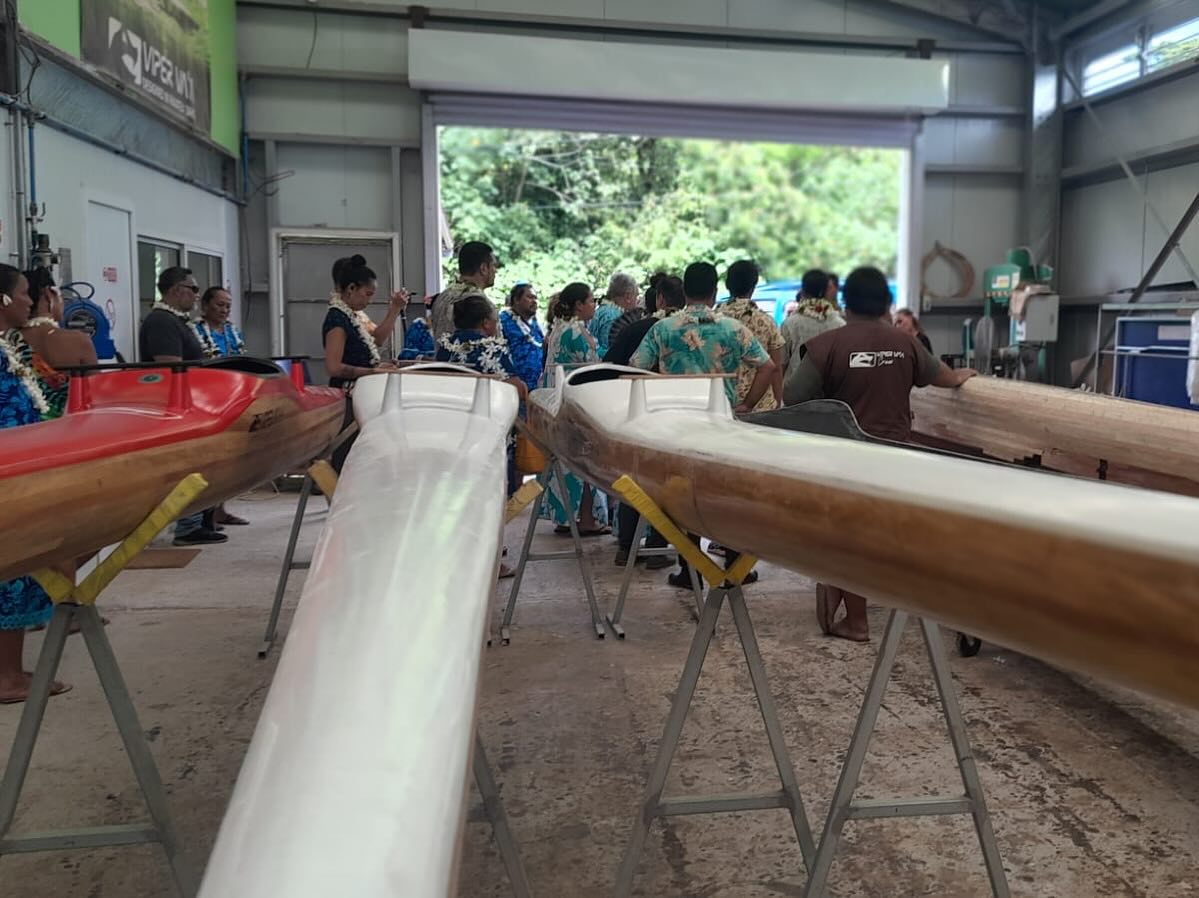
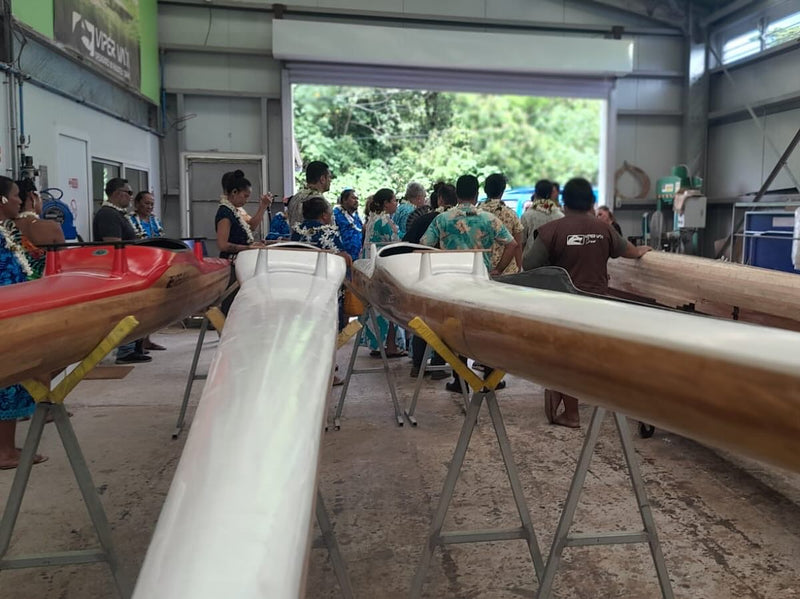
Hulls on trestles across the production floor — photo @vipervaa
Move 04

Lay The Carbon

Multiaxial carbon is cut, laid into the mold by hand, wetted out, and cured. This is the step machines don't do here — fifteen sets of hands, respirators on, building blades one at a time in a shed on the west coast of Ra'iātea.

The production floor. Photo · @vipervaa

Film · @vipervaa
Move 05

Pull It Fresh

The unmolding — a new blade peels out of the tooling, still sharp-edged, and heads for trimming, sanding, and finish work. Watch the clip: this is the moment a paddle becomes a paddle.

Blade unmolding, May 2025. Film · @vipervaa

Wood hull hoisted on chain blocks in the new shed — photo @vipervaa
Move 06

Shaft & Assembly

Bamboo or carbon, straight or S-bend, standard or thin diameter — the shaft meets the blade at the angle the size calls for, 9 to 10 degrees. Same hands, same roof: the crew builds everything here from kids paddles to V1s to six-man canoes light enough to hang from chain blocks.

The new 1,000 m² shed, opened 2025. Photo · @vipervaa

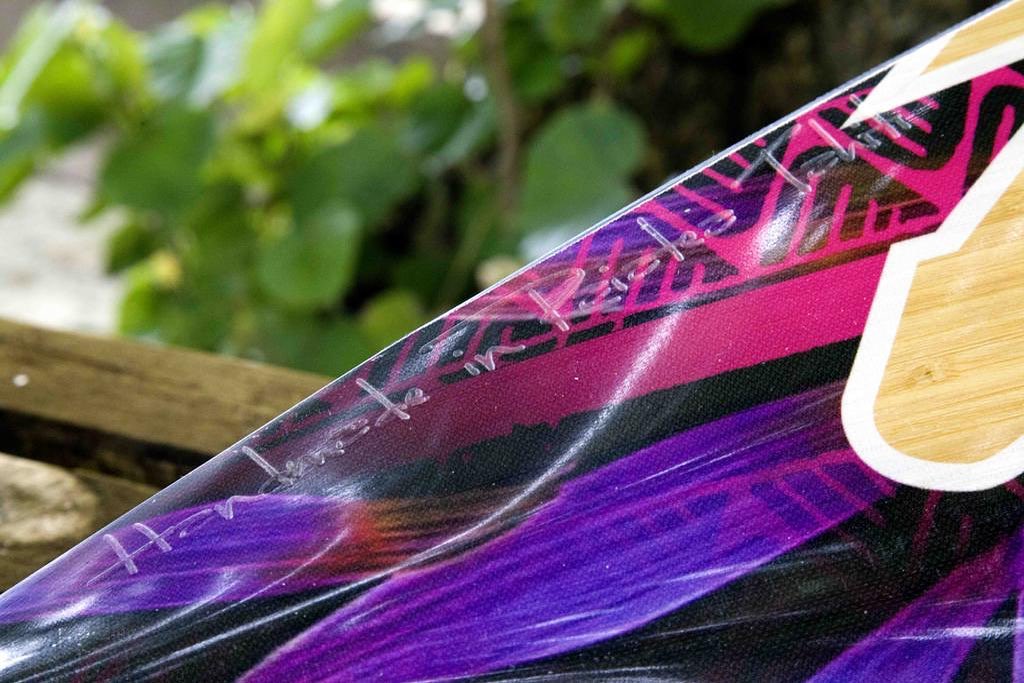
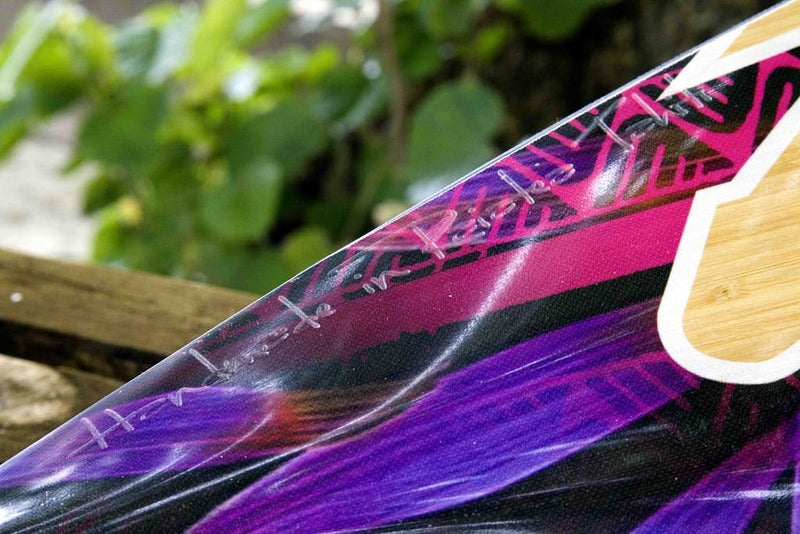
Blade edge hand-engraved Handmade in Raiatea Tahiti — photo @vipervaa
Move 07

The Art Pass

Forty-plus blade designs, many drawn with Ra'iātea artists — Polynesian patterns carried with respect, new collections every season, custom art for crews of ten or more. Then the signature move: every blade is hand-signed Handmade in Raiatea Tahiti. Details make perfection, and perfection is not a detail.

The hand-signed edge. Photo · @vipervaa

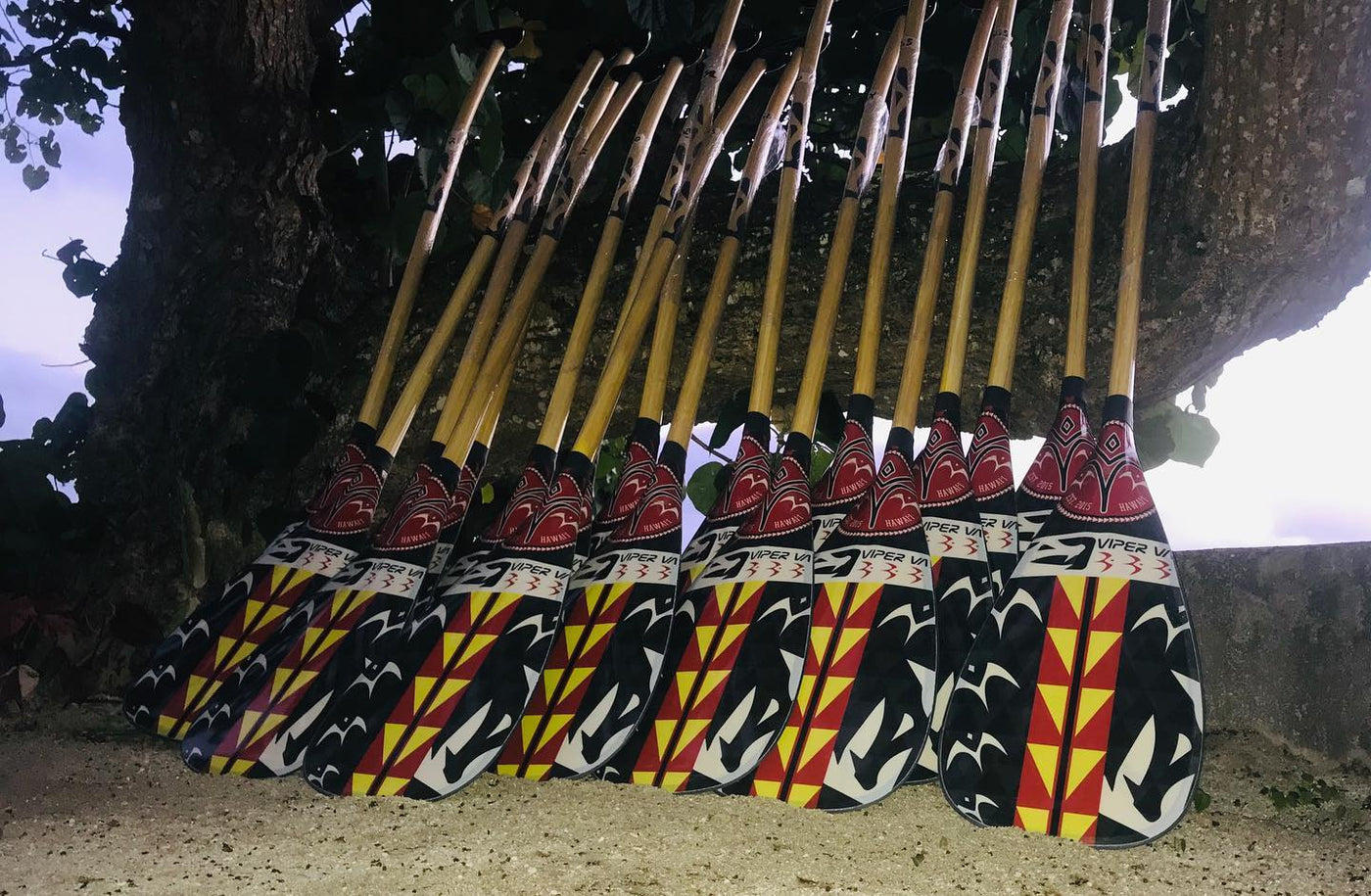
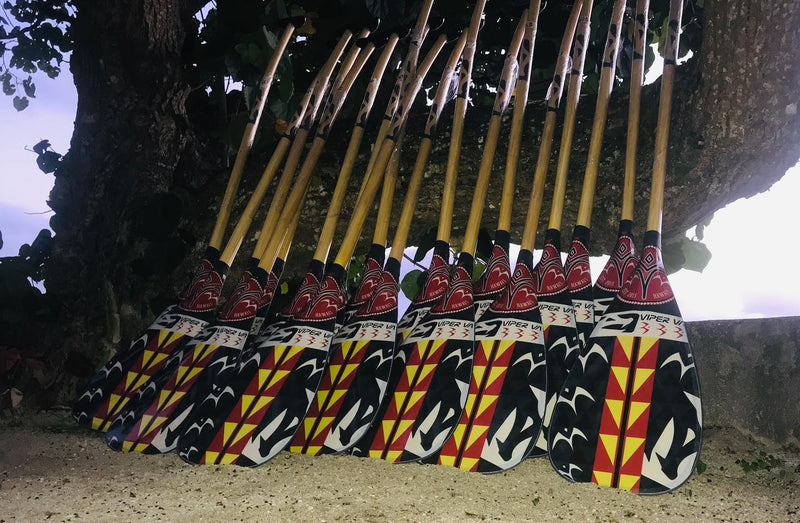
Custom crew batch of matched paddles under a Ra'iātea tree — photo @vipervaa
Move 08

Cut To You

Signed off, cut to your length in centimeters or inches — or shipped uncut if you'd rather dial it yourself — and packed for one of 35 countries. This batch slept one last night under a Ra'iātea tree before flying to a crew in Hawai'i. Yours flies to Southern California.

Custom crew order, outbound. Photo · @vipervaa

A just-finished bamboo-face lei blade outside the workshop — photo @vipervaa
The SoCal Va'a Promise

You'll See Yours Being Born

Order a custom through us and the story doesn't stop at checkout. When your blade comes off the mold in Tehurui, we send you the reveal shot from the shed — your paddle, hours old, half a world away and already yours.

Standard on every SoCal Va'a custom order · No extra charge

A just-finished blade in the Ra'iātea sun. Photo · @vipervaa

Bonus Footage

Forty Seconds In The Shed

Sound On
Film · @vipervaa

"Proud to build everything locally on the sacred island of Ra'iātea for nearly 20 years — a peek at the making of our products." Film · @vipervaa, June 2026

Watch on Instagram →

0
Est. Ra'iātea

Founded by Alex & Nathalie Pelou. Still family-run, still on the island.

0K
Paddles A Year

About 10,000 built annually — roughly 7,000 of them exported.

0
Countries

Hawai'i, the U.S. mainland, Japan, Brazil, Australia, Europe — 70% ships out.

0X
Hawaiki Nui

Seven titles for the EDT crew, all on Viper. Tahiti's other giant, Shell Va'a, paddles them too — as do champions at Molokai Hoe, Super Aito, and Te Aito.

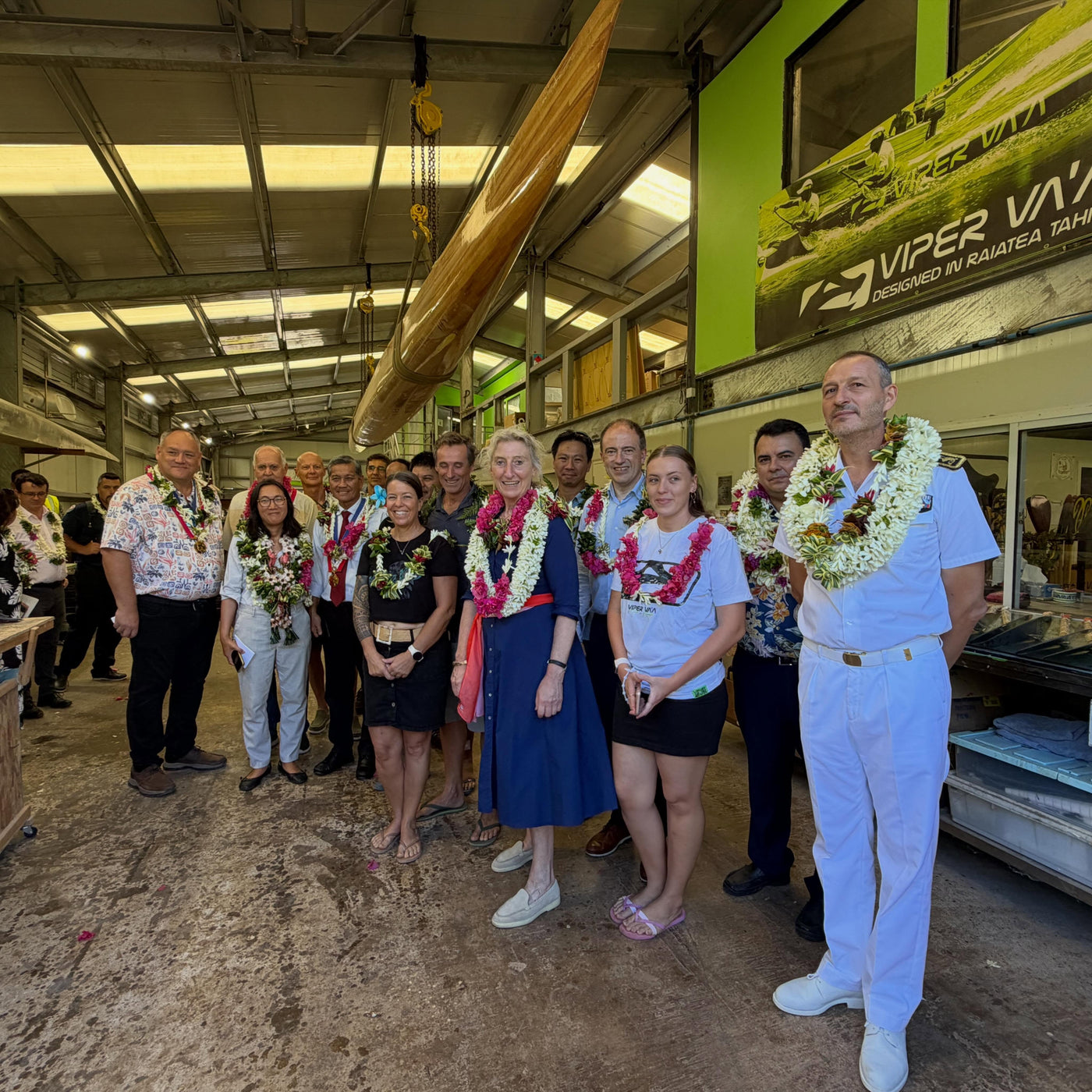
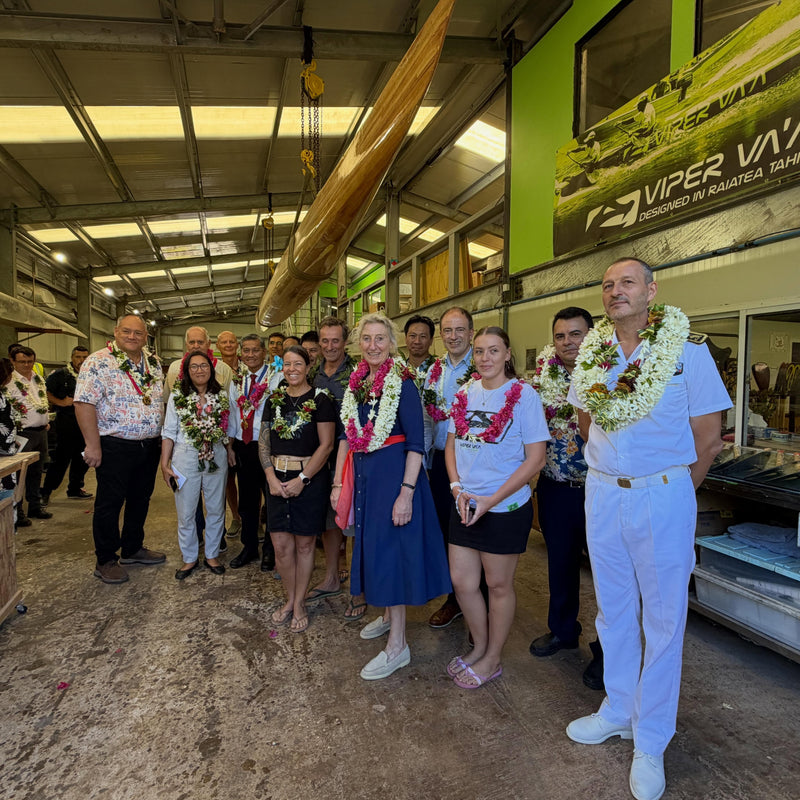
Crew and visitors with paddles under the Viper Va'a banner — photo @vipervaa
05 · Dial It In

Your Numbers, Their Hands

Every option below is a real decision made for your paddle in Ra'iātea. Over a hundred combinations before you even pick the art — this is why nothing off a rack compares.

Blade FaceCarbon / Bamboo
ShaftSoft · 100% Bamboo / Hard · Carbon
BendS-Bend / Straight
DiameterStandard / Thin
Blade Sizes22.5×47 → 26×48.5 · + Kids
The Art40+ Designs · Crew Customs
$399In Stock From · Customs From $369 With Prepay

Customs travel to Ra'iātea in batched orders — your deposit holds a slot in the next run · ~4 months, built from zero
In stock means on hand in SoCal — when they're gone, it's the queue · ~2 weeks

Matching lei blades — carbon face and bamboo face — photo @vipervaa
Concierge · No Guesswork

Don't Know Your Numbers?

Most paddlers don't — that's normal. Tell us your height, where you sit (or that you're in a V1), the water you paddle, and how your stroke feels, and we'll come back with the exact spec: blade size, face, shaft, bend, length. Straight answers before you spend a dollar. No upsell — the right blade is the one you'll still love in five seasons.

Same art, two faces — carbon or bamboo. We'll help you choose. Photo · @vipervaa

06 · The Crew

Built By Paddlers

The people who build your blade race it too.

Half the crew paddles for the west-coast club Alex helped found in 2018 — and the workshop's own team lines up at Hawaiki Nui Va'a, the three-day crossing that is to va'a what the Tour is to cycling. They finished 7th overall in 2023, on gear they built themselves that morning shift.

The rest of the world keeps finding the shed: the government of French Polynesia toured the new workshop when it opened, ocean navigator Catherine Chabaud dropped in this June, and in 2024 Viper carried the VenomWood to the Élysée Palace in Paris as one of the flagships of French making. Not bad for a repair bench that started fixing kite gear.

The workshop team racing Hawaiki Nui Va'a — photo @vipervaa

Workshop team, Hawaiki Nui Va'a — 7th overall, 2023. Photo · @vipervaa

Crews · Clubs · Teams

Order As A Crew

Tahiti's clubs order matched sets straight from the shed — same blade, same art, a crew that moves as one. Viper builds custom runs for crews of ten or more, and we coordinate them for Southern California clubs: one order, your colors, everyone's sizes.

Ten paddles minimum · Your club's art on every blade · We handle the back-and-forth with Ra'iātea

"Performance has nothing to do with luck."

— The line Viper Va'a has shipped on every batch since the early days

Ra'iātea → Southern California

Your Blade Is Waiting To Be Born

Every custom Viper we order is built exactly like this — your sizes, your shaft, your art, laid up by the crew in Tehurui and flown to SoCal. Or grab an in-stock blade and be on the water in two weeks.

$30 off every custom when you pay up front · And when yours leaves the mold, we send you the shot

Not Ready? Fair.

Stay In The Current

In-stock drops sell out and build windows come and go. One email when they do — that's the whole deal.

Drops + build windows only · Unsubscribe anytime · No spam, just reps

Straight From The Shed

Follow The Build

@Vipervaa →

Credits & Sources

Photos & film · Viper Va'a (@vipervaa), shared here with credit — confirm usage rights with Viper Va'a before publishing. Facts · vipervaa.com · Hine Magazine, "Alex et Nathalie Pelou de Viper Va'a" · Tahiti Infos, "Ça rame fort pour Viper" & "Le va'a en vedette à l'Élysée" · TNTV "Va'a Toa," workshop visit · Kanu Culture on Tahitian hybrid paddles. Cultural note · Viper's blade art draws on Polynesian patterns, much of it drawn with Ra'iātea artists — lineage we honor. Ra'iātea is the ancestral heart of the va'a world; it's an honor to paddle what it builds.