
Choose the right Outrigger Paddle Length
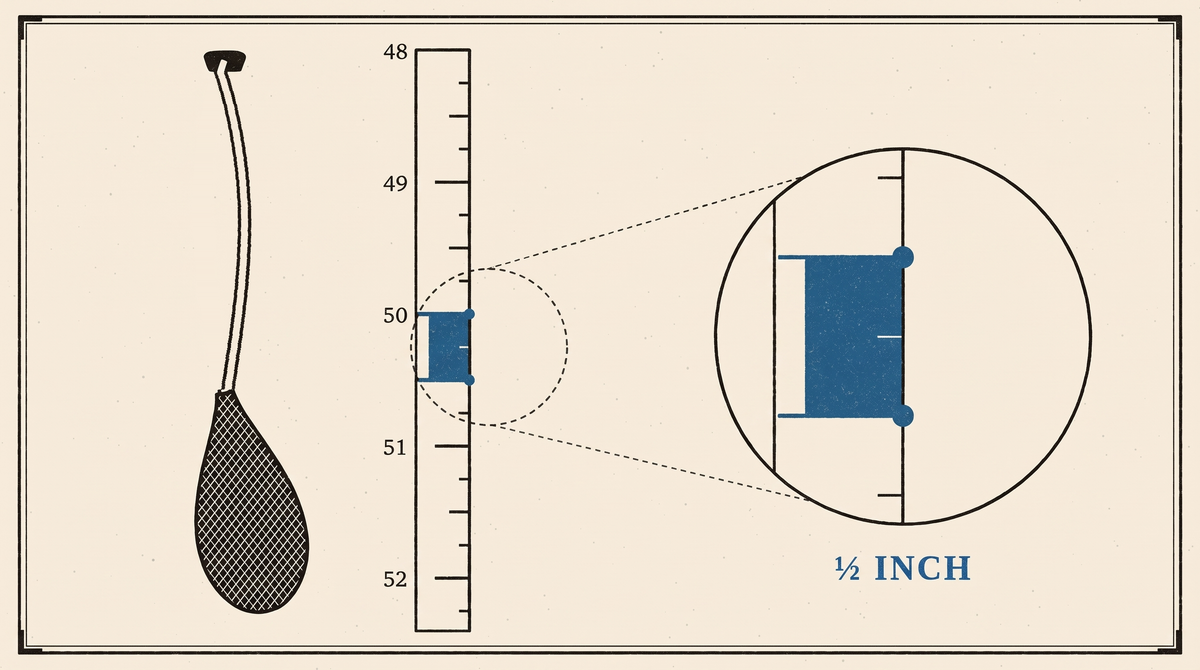
Start with a height chart to get your two-to-three-inch range, then subtract for a lower seat, then check it against your torso and shoulders, and round to the half inch. Most paddlers land between 48 and 52 inches. When you are still between two numbers, order the longer one — a Viper can be cut down later, it can never be made longer.
In this guide:
- Why no chart can finish this for you
- Step 1 — Get your range
- Step 2 — Adjust for your craft and seat
- Step 3 — Check it against your torso and shoulders
- Step 4 — Round to the half inch, and round up
Why no chart can finish this for you
Every sizing chart published for this sport hands you a range, not a number. That is not a flaw in the charts — it is what a chart keyed to one measurement can honestly do. The problem is that a custom Viper is cut in half-inch steps, so the chart leaves you with a handful of choices and no way to pick between them.
Take a paddler at 5 feet 10. Three published charts, read side by side:
| Your height | Kialoa | Quickblade | G'Power | Combined spread |
|---|---|---|---|---|
| 5′4″ | 47–49″ | 46–49″ | 46.9–48.8″ | 46–49″ |
| 5′8″ | 48–50″ | 47–50″ | 48.0–50.0″ | 47–50″ |
| 5′10″ | 49–51″ | 48–51″ | 48.8–51.2″ | 48–51.2″ |
| 6′0″ | 50–52″ | 49–52″ | 50.0–52.0″ | 49–52″ |
Kialoa publishes one range per height band. Quickblade publishes four columns — two blade families, each split between OC6 and the one- and two-person canoes — and the spread above is the full width of all four. G'Power publishes centimetres, converted here. Ranges are the sources' own; see the links in Where these numbers come from.
At 5′10″ that is a three-inch spread — six half-inch steps on the Viper order form. The charts agree on roughly where you belong and disagree on exactly where, by more than the increment you are being asked to choose. So treat the chart as step one of four, and keep going.
The charts say this about themselves. Quickblade puts this directly under its own table: “These are recommended paddle lengths by paddler height and are considered good choices for the majority of paddlers. Your personal preference, physical attributes or intended usage may require a choice different from the above recommendations.” Kialoa calls its chart “general guidelines.” G'Power labels its table “general sizing by paddler height.” Three sources, three disclaimers, no argument between them.
Step 1 — Get your range
Find your height on the table above and write down the range. Each chart is worth reading at the source, because each frames the decision slightly differently: Kialoa's sizing chart, Quickblade's four-column chart, and G'Power's cm chart.
You now have a two-to-three-inch window. Everything that follows narrows it.
Step 2 — Adjust for your craft and seat
This is the biggest single adjustment after height, and it is the one all three sources agree on: a one- or two-person canoe takes a shorter paddle than a traditional six.
They agree on the direction and disagree on the size of it, which is worth knowing rather than being told a single number:
| Source | What it says about craft |
|---|---|
| Kialoa | For a one- or two-person canoe or an unlimited OC-6, “go to the middle or low end of the range.” Most people use a shorter paddle in OC-1/OC-2s and unlimited OC-6s than in a traditional six-person canoe. |
| Quickblade | Publishes it as a fixed step: its OC1/OC2/V1 column runs exactly 1″ shorter than its OC6 column, at every one of its 33 height rows. |
| G'Power | Subtract 2–5 cm — about 0.8 to 2 inches — for OC1, because the solo canoe sits lower in the water and a shorter paddle keeps the stroke vertical. |
The mechanism is how high you sit above the water, not what the boat is called. A solo canoe sits you lower, so less paddle is needed to reach the same water. An unlimited OC-6 sits lower than a traditional one, which is why Kialoa groups it with the solo boats rather than with the six-man. If you paddle an OC6, G'Power adds one more wrinkle: the front seats tend to run shorter than the back, because the bow rides higher and the catch angle changes down the boat — one crew can carry four or five different lengths.
So: paddling OC1, OC2, V1 or an unlimited OC-6, come down from the middle of your range toward the low end. Paddling a traditional OC6, stay in the middle or go up. Steering is a different question with a different answer, and it is not this guide's — ask us if that is what you are sizing.
Step 3 — Check it against your torso and shoulders
Height is a proxy. What actually sets your length is how much of that height is torso, and how high your shoulders sit when you are seated — which is why two paddlers the same height can want different paddles.
Two of the sources give you a way to check:
- Kialoa: if you have broader than average shoulders, or a longer than average torso for your height, go to the high end of your range.
- PNWORCA, a paddling association rather than a builder, publishes a club rule of thumb: sit on a standard chair with no padding, measure from the chair seat to your chin, then add the length of the blade. It calls that “a good idea where to start,” and says plainly that there are many philosophies about length. Treat it as a cross-check on the chart, not a replacement for it.
- G'Power: stand flat-footed with the paddle upright beside you — the T-grip should reach your sternum. That gives an OC6 starting point, which you then adjust for craft as in step 2.
If two methods put you in the same half of your range, that is your answer. If they disagree, you are genuinely between sizes, which is what step 4 is for.
Step 4 — Round to the half inch, and round up
Now you have a number with a half inch of doubt in it. Here the custom build stops being a complication and becomes the reason this decision is recoverable:
Cut in half-inch steps. Not sure? Guess a touch long — a paddle can always come down, it can never grow back.
That is from our own order guide, and it is the most useful sentence on this page. The asymmetry is the whole point: ordering half an inch long leaves you a paddle that can be trimmed. Ordering half an inch short leaves you a paddle you can only replace.
Still between two numbers? Take the longer one. That is not a hedge — it is the only one of the two mistakes you can undo. A paddle ordered long can be brought down later; a replacement T-handle is a stocked part. A paddle ordered short cannot be extended at all. Getting this wrong in the long direction costs you a trim. Getting it wrong in the short direction costs you the paddle.
Does the half inch actually matter? It matters enough that a quarter of the people ordering a custom Viper use it. Of the custom paddles ordered through this shop, 26.7% chose a half-inch length rather than a whole inch, and 89.3% landed somewhere between 48 and 52 inches.
Read that as where people land, not as what is correct. It is what this shop's customers chose, not a recommendation and not a finding about the sport — the sample is one small retailer's order history. Popular is not better. If your range and your torso check both point outside 48–52, they are better evidence about your paddle than anybody else's order is.
Outrigger Paddle Length FAQs
Q1What size outrigger paddle do I need?+
Q2Should my OC1 paddle be shorter than my OC6 paddle?+
Q3Is it better to go too long or too short?+
Q4Can a Viper paddle be cut down after I order it?+
Q5Do the half-inch sizes actually matter?+
Still between two numbers?
Then stop guessing and ask — it is free, and it is cheaper than a trim. Tell us your height, your craft and your seat, and how your current paddle feels, and we will propose a length: free spec help.
When you are ready to build: the order guide walks the whole spec, and the Custom Viper collection is where you set your numbers. Length is one of five decisions — flex, bend and diameter are the shaft, surface area and shape are the blade, and bamboo or carbon is what the shaft is made of. This guide is only the length.
Where these numbers come from
The three height charts are published by Kialoa, Quickblade and G'Power; the fitting rule of thumb is PNWORCA's. All four were read live on 26 September 2026. The half-inch rule and the round-up line are from our own order guide. The order shares are SoCal Va'a's own order records, re-counted the same day.