
Choosing Your Viper Shaft: Flex, Bend & Diameter
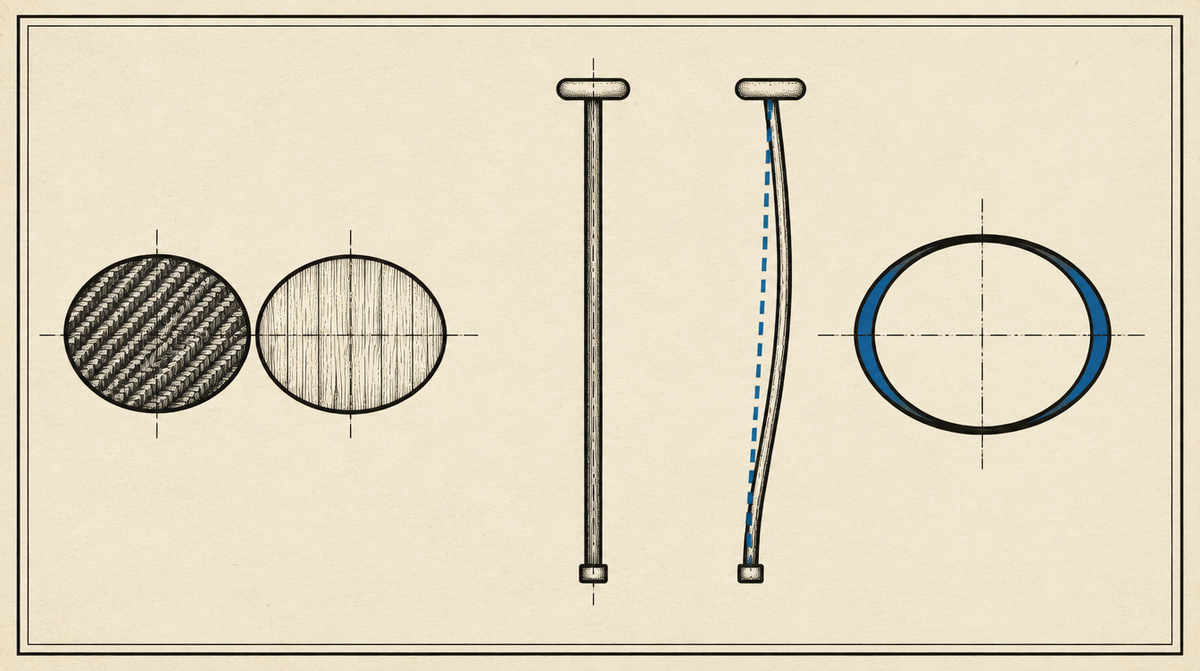
Three choices decide how your Viper shaft feels in the water, and they don't carry equal weight. Flex changes the paddle most — hard carbon is quick and sharp, soft bamboo gives and springs back. Bend is a comfort-and-control preference, not a speed upgrade. Diameter is a hand-fit check. Decide them in that order and the last two get easy.
This is the shaft half of a custom Viper. The blade half — surface area, shape, angle — is its own decision, and it starts with surface area. The order guide walks the whole build.
Quick callWhich Shaft Is Yours?
| Decision | Your two options | Who each suits |
|---|---|---|
| Shaft flex | Hard (100% carbon) · Soft (100% bamboo) | Hard — sprints, short explosive efforts, a catch you trust. Soft — distance, long sessions, and paddlers whose joints have complained before. |
| Shaft bend | S-bend (double bend) · Straight | S-bend — comfort, control, long sessions, V1 steering corrections. Straight — the lightest, simplest, most direct paddle in the rack. |
| Shaft diameter | Standard 32 × 26 mm · Thin 29 × 25 mm | Standard — larger hands. Thin — smaller hands. Grip comfort, nothing else. |
Why that order: flex changes the paddle's whole character, bend changes how it sits in your hands, and diameter changes how it feels to hold. Biggest consequence first.
Decision 01Shaft Flex: Hard Or Soft
Hard if you sprint. Soft if you go long. Viper builds two: Hard (100% carbon), stiff and quick-responding, and Soft (100% bamboo), which flexes under load and springs back. This is the choice that changes the paddle most, because it decides where your effort goes.
A stiff carbon shaft barely flexes, so nearly all your force reaches the water instantly. That directness is why it's the sprinter's pick — short, explosive efforts where timing and response matter.
A bamboo shaft behaves like a spring, and that cuts both ways. Loading the pull stores energy by bending, then releases it when you relax at the exit — and the exit is the one place in the stroke where that energy can't drive the boat. Some of it is genuinely lost. What you get back is real too: the spring softens the load spike at the catch, and the recoil helps your rhythm and recovery. That trade is why hybrid paddles are so common in team racing despite the small efficiency cost.
So neither option is free. Carbon buys you response and pays in shock — a stiff shaft punishes a mistimed catch by sending it straight into your body, and carbon is brittle at its limit, breaking rather than bending. Bamboo buys you comfort and control and pays a little efficiency for it.
Where that cost lands is your joints. Bamboo is the forgiving one, and it forgives twice over: the shaft bends to blunt the load spike at the catch, and the bamboo itself damps the vibration behind it. Carbon does neither, by design — it is built to transmit, which is exactly what makes it feel so direct, and exactly why a mistimed catch travels straight up a hard shaft into your wrists, elbows and shoulders. Clean technique closes most of that gap. But a hard shaft is less willing to cover for you when the catch slips, and a soft one rewards a smooth, rhythmic stroke. Neither is a guarantee either way, but Soft is the more likely of the two to protect your joints across a long season. That is why paddlers with elbow, wrist or shoulder history commonly reach for Soft, and why Soft is the more forgiving shaft for anyone still grooving their catch.
Pick Hard for sprint response and the lightest, stiffest build. Pick Soft for distance, shock absorption, and joints that have complained before.
Want the materials themselves in depth — stiffness, energy return, damping, lifespan, care and what each one costs? Bamboo or carbon: what each shaft material actually does.
Decision 02Shaft Bend: S-Bend Or Straight
Mostly preference — and be honest about that. A double bend will not automatically make you faster. The comfort and control it buys you can. It is also, by a very wide margin, the one people order — about 98% of the custom Vipers we've built have been S-bends. Popular and better are different things, though. Worth knowing; not a reason on its own.
On a straight shaft, your bottom wrist has to cock to keep the blade square as the paddle rotates through the stroke. An S-bend builds that angle into the shaft, so the wrist stays neutral and you can wrap a full fist earlier. Neutral wrists fatigue slower and take less strain, which is the main reason paddlers with wrist, elbow, or shoulder history prefer an S-bend.
The crank also works as a small fulcrum. It shifts how the blade presents, keeping it vertical and loaded a touch longer through the pull, which you feel as control and drive — especially steering a V1. It also means you can run a slightly shorter overall paddle for the same reach.
The cost is straightforward: that extra kink makes the shaft effectively longer for a given paddle length, so it weighs a little more and swings heavier. Racers chasing the snappiest possible paddle stay straight.
A straight shaft gives a direct, connected sense of driving down the shaft into the blade, and it's simpler across varied strokes. Lighter, simpler, more direct.
Bend has its own guide: Double Bend or Straight? Choosing Your Viper Shaft Bend works the decision all the way down, including what bend does not change about your blade angle.
Steve West's guidance on team canoes is blunt: mixing shaft angles and types “compromises uniformity of paddling technique and power bands,” and crews need to be on “the same sticks,” with blade width and paddle length the only variables worth differing.
Sort the crew's shaft type before anyone orders.
Decision 03Shaft Diameter: Standard Or Thin
Hand size. That's the whole decision. Viper offers two, both oval.
Three Millimetres, Every Stroke
| Standard | 1.26 × 1.02 in | 32 × 26 mm |
| Thin | 1.14 × 0.98 in | 29 × 25 mm |
| Difference across the wide axis |
3 mmThe smallest of the three choices | |
Published Viper shaft specifications · wide axis × narrow axis
It's the smallest of the three choices, and it won't transform your stroke. What it does affect is your grip, which you hold for every stroke of every session.
Too thick and the hand can't close comfortably; the forearm fatigues and cramps over distance. Too thin and larger hands lose stability and start over-gripping. Matching diameter to your hand keeps the grip relaxed, which is what saves your forearms late in a long race.
Both are oval rather than round, and that flat gives you something useful: it indexes the blade angle by feel, so you know the blade is square without looking.
Larger hands → Standard. Smaller hands → Thin.
Putting it togetherHow The Three Add Up
You don't pick a paddle weight on a Viper. Weight is what falls out of the flex and bend choices you already made — so make those two on their merits and the weight takes care of itself.
Sprint-leaning: Hard carbon + straight shaft. The stiffest, lightest, quickest build available — maximum response, minimum swing weight, least forgiveness for a sloppy catch.
Distance-leaning: Soft bamboo + S-bend. The most shock absorption and the most comfort, carrying a little more mass for it. The combination that hybrids earned their reputation on.
Most paddlers land in between, and that's fine — these aren't a matched set. Pick flex for how much shock you want absorbed — or how little — bend for your wrists, and diameter for your hands. Then size the length.
Viper Shaft FAQs
Straight answers on flex, bend and diameterQ1Hard or soft shaft — which should I get?+
Q2Is a double bend better than a straight shaft?+
Q3Does a double bend make the paddle heavier?+
Q4Which shaft diameter should I choose?+
Q5Do OC6 crews need to match shaft types?+
Ready To Build?
Flex, bend, diameter — that's the shaft settled. The order guide walks the rest of the build, blade included. Not sure? Spec help is free — tell us your height, your craft and seat, the water you paddle, and how your current paddle feels.
Grounded in the approved SoCal Va'a Knowledge Base articles “Paddle Material — Blade & Shaft,” “Double Bend (S-Bend) vs Straight Shaft,” “Paddle Length & Shaft Diameter,” “Paddle Weight — Pros & Cons” and “Customer Paddle Spec Guidance” · Crew-matching guidance: Steve West, “Double Bends,” Kanu Culture · Shaft specifications from the live Custom Viper listing · S-bend order share from SoCal Va'a order records