
Double Bend or Straight? Choosing Your Viper Shaft Bend
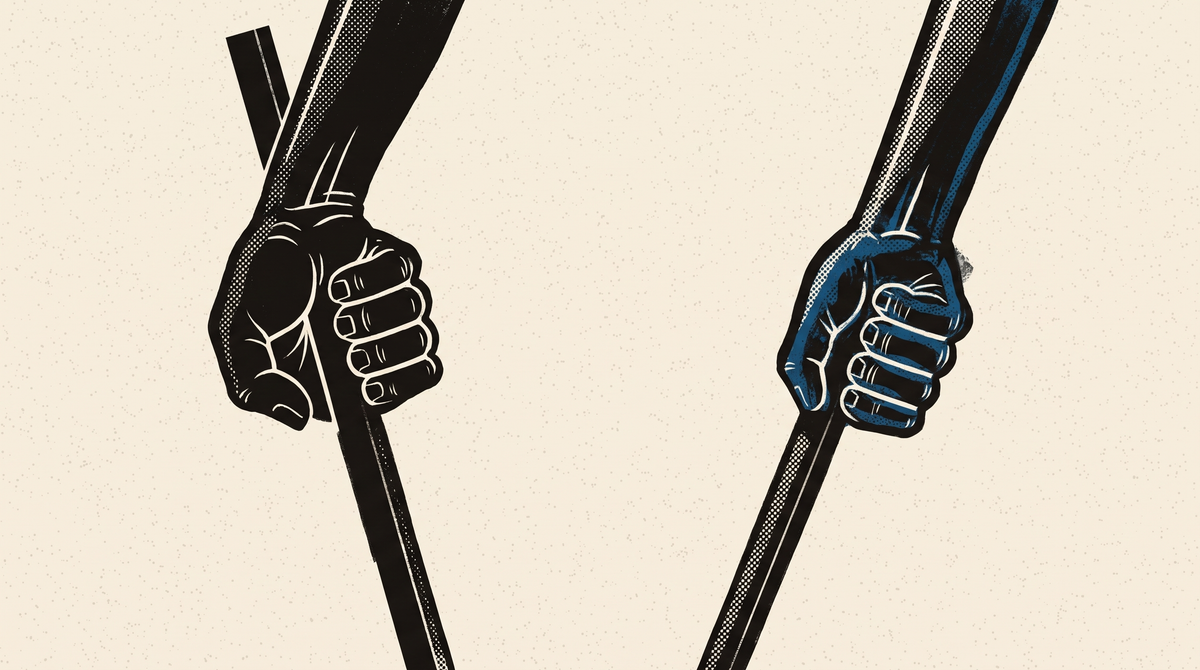
Two shapes, one decision about your lower hand. An S-bend builds your bottom wrist's angle into the shaft, so the wrist stays neutral and you can wrap a full fist earlier. A straight shaft is lighter, simpler and gives you a more direct sense of driving down into the blade. Neither one is faster.
What this page adds to Paddle Shafts 101, where bend is one of three decisions: the whole mechanism, what the choice actually costs you, the published case against the S-bend, and what bend does and does not change about the rest of your spec. Flex and diameter stay on the shaft guide. Blade size, shape and angle stay on the blade guides. This page is bend, all the way down.
The Two Shapes, Precisely
Viper builds two, and the names on the order form are the ones to go by.
- Double Bend — also called an S-bend. The shaft kinks twice, so the grip section and the blade section sit at ergonomic angles.
- Straight Shaft — the traditional shape, no second kink.
Now the trap, because we field this one constantly. Most of the sport says “single bend” where we say Straight Shaft. It sounds like a third option. It is not. And a single bend is not an unbent stick either — the bend it is named for is the angle where the blade meets the shaft, which every outrigger paddle has, ours included. KIALOA lists most of its single bends at 10° there. A Viper Straight Shaft carries 9° or 10°, depending on the blade you pick.
So if you have been reading about single bends elsewhere, you have been reading about what we call a Straight Shaft, and it has an angled blade.
| Viper's name | What the sport often calls it | Second bend near the T-top? | |
|---|---|---|---|
| The bent one | Double Bend (S-bend) | Double bend, S-bend | Yes |
| The other one | Straight Shaft | Single bend | No |
Viper’s two shaft shapes, and the terms a cross-shopping buyer meets elsewhere · Live order form
What the Crank Actually Does to Your Lower Hand
This is the whole decision, so here it is properly.
On a straight shaft, your bottom wrist has to cock. As the paddle rotates through the stroke, keeping the blade square means bending the wrist away from neutral and holding it there under load, stroke after stroke. It works — most of the sport paddled that way for a long time — but it is your wrist doing the geometry.
An S-bend builds that angle into the shaft instead. The kink puts the grip section where your cocked wrist wanted to be, so the wrist stays neutral and you can wrap a full fist earlier in the stroke rather than gripping around an awkward angle. Neutral wrists fatigue more slowly and take less strain. That is the main reason paddlers with wrist, elbow or shoulder history reach for an S-bend.
Then there is the crank as a lever. The bend acts as a small fulcrum, shifting how the blade presents through the pull so it stays vertical and loaded a touch longer. You feel that as control and drive. It matters most in a rudderless boat: in a V1, the extra bend up toward your top hand is what gives you leverage on a steering pry at the end of the pull. That is the single most common reason the V1 paddlers we build for choose an S-bend.
And one knock-on you can feel immediately: because the upper shaft is angled back toward you, a slightly shorter overall paddle reaches the same water. More on that below, because it changes a number you are about to type into the order form.
What It Does Not Change: Your Blade Angle
Short section, and the most important one if you are cross-shopping.
On a Viper, shaft bend and blade angle are separate decisions. Blade angle is part of the blade choice — it is baked into the option name (Round 10°, Round 9°, Square 9°), which is Decision 5 on the order guide. Bend is Decision 2. Both angles are available on either shaft. Choosing an S-bend does not hand you more blade angle, and choosing a Straight Shaft does not cost you any.
Why you may have heard otherwise. KIALOA’s own paddle-choosing page says double bends “tend to have more blade angle,” and puts its double bends at “10 to 16 1/2 degree angle at the blade, which varies by model” — Paea at 16°, Hoku and Mekana at 16.5°, Teva Hoe at 15°. Read that last clause again: it is a builder describing its own catalogue. The figures are accurate. They are not a rule of the sport, and they are not how we build.
The mechanism behind it is real, and worth understanding. A second bend near the T-top tilts the shaft forward at your bottom hand, which reduces the angle the water actually sees. A builder can compensate by specifying more static blade angle on its double bends. KIALOA does. We don’t — the same 9° and 10° blades are offered on both shafts, and the choice is yours.
So the rule does not transfer. If you are configuring a Viper, pick the blade angle you want and pick the bend you want, in either order. What each angle does to your stroke is a different question, answered in Blade Angle: 9° vs 10°.
Reach, Length and the Shorter Paddle
Here is where bend touches a number you actually have to give us.
The crank angles the upper shaft back toward you. For the same overall length the shaft works out effectively longer, there is less emphasis on driving straight down, and a slightly shorter paddle reaches the same water. Same reach, less stick.
What to do about it: sort your bend first, then size your length to it. A length that was right for you on a straight shaft may be slightly long on an S-bend. This is the one place the bend decision reaches into another spec, and it only runs in that direction.
Two practical notes:
- Don't re-decide length here. Viper cuts in half-inch steps and the guidance is to guess a touch long if you are unsure, because a paddle can always come down and can never grow back. The full length decision is Decision 4 on the order guide.
- If you are switching from a straight shaft to an S-bend, don't just copy your old number across. That is the situation this section exists for.
The Honest Case Against the S-Bend
We sell both, we build both, and about 98% of the custom Vipers we have built have been S-bends. Which makes this the section that earns the rest of the page, and the one most paddle sellers leave out.
Start with the one real mechanical criticism in print, because it is worth understanding rather than dodging. It comes from Steve West, and it is an argument about manufacturing rather than about bent shafts as an idea. The earliest double bends were made by cutting a single-bend paddle and scarfing the upper shaft back on reversed. That gave a hard, definite crank pivoting on one fixed point. Jigs replaced it — laminates bent into a single continuous curve — and his objection is that the change was a production decision, not a design improvement.
His charge against the curve that replaced it: the fulcrum is no longer fixed but “progressive,” shifting under load, which he argues makes it less positive and less accurate for adding push and leaves weaker designs feeling “wayward.” He also allows that the better ones still offer real mechanical advantage and stay central to V1 and V6 paddling.
Here is where we land on it. The criticism lands on the continuous-curve S-bend as a category, and on the weak examples of it — not on the idea of a bent shaft. It is a fair point about cheap tooling, and the honest conclusion is that a bend is only ever as good as the builder who put it in. We sell both shapes and finish both in Oceanside, so we have no reason to talk you into either one.
The other costs are simpler:
- Weight and swing weight. The extra kink makes the shaft effectively longer for a given paddle length, so an S-bend weighs a little more and swings heavier. Racers chasing the snappiest possible paddle stay straight.
- It asks more of you. Getting the most out of the angles in the shaft takes attention, and the steering payoff in a V1 is far more obvious than anything in a plain forward stroke. The non-forward strokes — reverse, scull, draw — are slightly harder too, though you rarely use them in outrigger.
- It is not faster. A double bend will not automatically make you quicker. It buys comfort and control, and control is what gets you from A to B faster — the paddle is different, not superior. Anyone telling you a shaft shape will add speed on its own is selling you something.
Why we still build and sell both. Because these are trades, not a ranking. The S-bend buys wrist comfort and control and charges you weight and a little directness. The straight shaft buys lightness, simplicity and a direct connected feel, and charges your bottom wrist. Neither is an upgrade on the other.
Crews: One Place Bend Is Not Your Decision
If you paddle OC6, shaft type is a crew call before it is a personal one.
Mixing shaft types down one hull costs you uniformity of technique and power band. A crew wants the same sticks. Blade width and paddle length are the two variables that can differ between seats — and should.
The reason follows from everything above. An S-bend holds the blade loaded a touch longer through the pull; a straight shaft does not. Six paddlers trying to hit the same catch at the same instant, half of them on a blade that presents differently, are blending two slightly different power curves.
What this means for a crew order: sort the shaft type before anyone orders. Viper bend is a per-paddle build choice on a custom paddle, so a crew that has not agreed ends up with a mixed set and no cheap way back. Blade width and paddle length stay per-paddler — those are sized to the person, and flattening them would put most of the crew on the wrong gear. Diameter is per-paddler too; it is grip fit, and has nothing to do with how the crew's strokes sum.
One sequencing note that catches crews out: because an S-bend allows a slightly shorter paddle for the same reach, a crew that standardises on S-bends may find their lengths land shorter than the same paddlers would run on straight shafts. Shaft type first, then lengths.
What Most Viper Buyers Choose
About 98% of the custom Vipers we have built have been S-bends. Recounted from our own order history on 2026-09-26.
Popular and better are different things. That number tells you what this customer base picks — a lot of them distance paddlers, a lot of them people who came to us for wrist comfort in the first place. It is not evidence that the S-bend performs better, and the straight shaft is not a lesser paddle for being rare here. Worth knowing; not a reason on its own.
Shaft Bend FAQs
Straight answers on bend, blade angle and lengthQ1What is a "single bend" paddle, and is that what Viper calls a Straight Shaft?+
Q2Does an S-bend change the blade angle I should order?+
Q3Should I order a shorter paddle if I choose an S-bend?+
Q4My wrists hurt — will an S-bend fix that?+
Q5Why do almost all Viper buyers order an S-bend?+
Ready to Build?
Work through the rest of the spec in the custom-order guide, or go straight to the Custom Viper collection. Flex, diameter and length are all covered in Paddle Shafts 101.
Still torn between the two? Spec help is free — it is a short conversation, and it is cheaper than a custom build you are not sure about.
Grounded in the approved SoCal Va’a Knowledge Base articles “Double Bend (S-Bend) vs Straight Shaft,” “Blade Angle & Its Impact on the Stroke,” “Paddle Weight — Pros & Cons,” “Customer Paddle Spec Guidance” and “OC6 Crews — What to Match and What Can Vary” · Progressive-fulcrum criticism and the manufacturing history: Steve West, “Double Bends,” Kanu Culture · Single-bend terminology and the quoted own-range figures: KIALOA, “How to Choose an Outrigger Paddle” · Shaft and blade options from the live Custom Viper listing · S-bend order share re-derived from SoCal Va’a order records, 2026-09-26